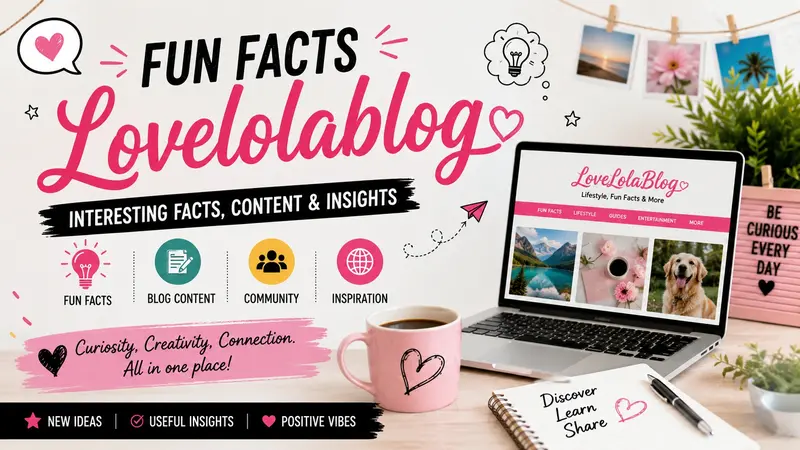
Searching for Fun Facts Lovelolablog usually means you want more than a random list of trivia. You may want to understand the blog, its content style, popular themes, and the ideas that make the platform interesting.
LoveLolaBlog has developed an online presence around varied informational content. Its current website includes a dedicated Fun Facts category alongside articles covering lifestyle, culture, practical topics, entertainment, and other subjects.
However, many articles published elsewhere make detailed claims about the blog’s origins, team, growth, audience, and history. Those claims do not always appear consistently across sources. Therefore, separating observable information from unsupported online statements is important.
This guide takes a closer look at the topic. It explains what readers can find, why the content attracts curiosity, how to evaluate claims, and what bloggers can learn from this type of content strategy.
What Is LoveLolaBlog?
LoveLolaBlog is a content website with a broad range of topics rather than a platform focused on one narrow subject.
Its current website organizes posts into categories such as Fun Facts and Interesting Facts. Recent content includes subjects related to lifestyle, technology, culture, entertainment, guides, and other general-interest themes.
This broad approach gives the site opportunities to attract readers with different interests. Someone might arrive through a trivia search and then discover another useful guide.
That discovery process is valuable for content websites. A single article can become the first step in a longer browsing session.
The site’s homepage also highlights several different content categories and guides, showing a broad publishing strategy.
Why Are People Interested in Fun Facts?
People enjoy facts that challenge expectations.
A good fact can make someone stop scrolling, think about a familiar subject differently, or share the information with another person. That makes trivia naturally suited to online publishing.
However, interesting information needs context.
A fact without an explanation can feel like a random statement. A better article explains why the detail matters and gives readers enough background to understand it.
That principle applies to blog-related searches too.
Readers do not simply want repeated claims. They want useful answers that help them understand the subject.
7 Interesting Things to Understand About the Platform
Rather than presenting questionable stories as confirmed history, these points focus on observable characteristics and useful lessons.
1. It Uses a Broad Content Strategy
One notable characteristic is topic variety.
The website does not limit itself to a single narrow subject. Its published material spans multiple areas, which can help a site reach different search audiences.
A broad strategy can work when every article still serves a clear purpose.
Without that focus, however, variety can become confusing. Strong websites need organization so visitors can quickly find what interests them.
2. Fun Facts Are an Important Content Category
The site currently has a dedicated Fun Facts category. That category contains articles covering very different subjects.
This tells us something important about the publishing model.
Fun facts are not necessarily limited to historical trivia. They can cover places, culture, technology, entertainment, lifestyle, hobbies, and everyday experiences.
That flexibility makes the format useful for attracting informational searches.
3. The Content Uses Curiosity-Driven Titles
Many articles use titles that promise discoveries, explanations, or surprising information.
That style works because readers naturally want to close an information gap.
For example, a headline that suggests readers will discover something unexpected can create a strong reason to click.
However, the article must deliver on that promise. Otherwise, the headline may attract visitors but fail to build trust.
4. The Website Covers More Than Trivia
Another useful observation is that the site’s current content is not limited to traditional fun facts.
Its homepage and category pages show a mixture of guides, lifestyle subjects, informational articles, and other general-interest topics.
That creates a broader content ecosystem.
Readers can discover different subjects without leaving the same domain. From an editorial perspective, that can also create opportunities for related internal links.
5. Readers Should Check Historical Claims Carefully
This is perhaps the most important point.
Several third-party pages describe a detailed origin story involving a small team, specific dates, early projects, viral posts, meetups, or other milestones. However, these stories vary between websites.
That inconsistency means readers should not automatically treat every repeated statement as fact.
The best practice is to verify important details through the website itself or trustworthy independent sources.
6. The Platform Demonstrates the Power of Topic Expansion
A website can begin with one content concept and expand into related areas.
That strategy can increase the number of potential search opportunities.
For example, a reader interested in trivia may also enjoy lifestyle content, practical guides, culture, or entertainment.
The key is relevance. Expansion should feel useful rather than random.
7. The Search Term Has Developed Its Own Content Ecosystem
The query now appears across multiple websites publishing guides about the subject. Some pages focus on trivia, while others discuss blogging, lifestyle, community, or content strategy.
This indicates that search intent is not completely one-dimensional.
A strong page should therefore answer the basic question while also providing useful context.
What Makes Fun-Fact Content Effective?
Successful trivia content usually combines three ingredients.
The first is surprise.
Readers should discover something they did not expect.
The second is clarity.
The information should be easy to understand without complicated language.
The third is context.
Readers should know why the fact is interesting.
Consider the difference between these approaches:
“This place has an unusual history.”
That statement creates curiosity but provides little value.
A stronger explanation identifies the historical detail, explains its significance, and provides a reliable source when necessary.
This simple difference can transform thin content into useful content.
Fun Facts Lovelolablog and Search Intent
Understanding search intent is essential when creating content around a specific phrase.
A person searching this topic may have several questions:
- What is LoveLolaBlog?
- What type of content does it publish?
- Why is the phrase appearing in search results?
- What makes the blog interesting?
- Are claims about its history reliable?
- What can bloggers learn from its content strategy?
A page that answers these questions provides more value than one that repeats the same keyword.
That is why this article focuses on explanation rather than keyword stuffing.
Google’s systems aim to understand content and usefulness, not simply count repeated phrases. Therefore, natural language and complete topic coverage are more sensible than forcing an exact phrase into every paragraph.
A Simple Content Comparison
| Content approach | Reader value | Main weakness |
|---|---|---|
| Random trivia list | Medium | Little context |
| Short blog overview | Medium | May lack depth |
| Detailed factual guide | High | Requires research |
| Search-focused article | High | Needs natural writing |
| Comprehensive guide with verification | Very high | Takes more research |
The final approach is the strongest when the goal is long-term usefulness.
It gives readers information while also addressing doubts and common questions.
How to Verify Claims About a Blog
Online information can spread quickly.
One website publishes a claim. Another copies it. A third website repeats it again. Eventually, the statement may look established even when nobody has checked the original source.
You can avoid this problem with a simple process.
Check the Official Website
Start with the site’s own pages.
Look at its homepage, About page, category pages, and older posts. These pages can reveal what the website actually publishes.
Compare Independent Sources
Do not rely on a single third-party article for important information.
Compare multiple independent sources and look for consistent evidence.
Look for Dates
A website can change significantly over time.
An article written several years ago may describe an older version of the platform. Current pages can provide a more accurate picture of what visitors see today.
Separate Facts From Opinions
Statements such as “the blog feels welcoming” are subjective.
Claims about dates, team sizes, traffic figures, revenue, or major milestones are factual claims and require stronger evidence.
This distinction improves content quality.
What Bloggers Can Learn From This Topic
The subject also provides useful lessons for content creators.
Build Around Reader Curiosity
Questions can make strong content foundations.
Instead of choosing a topic only because it contains a keyword, identify what the searcher actually wants to discover.
Create Useful Topic Clusters
One article can introduce a subject. Related articles can then answer narrower questions.
For example, a broad blog guide could connect to separate articles about content categories, blogging ideas, audience engagement, or writing techniques.
This creates a logical internal structure.
Keep Headlines Honest
A curiosity-driven headline can attract clicks.
However, the content must deliver the promised information.
A misleading title may generate a short-term click but reduce reader trust.
Add Original Value
Repeating information found on five competing pages does not create a better resource.
Instead, look for missing questions, unclear claims, outdated information, and areas that need more explanation.
Then address those gaps.
Common Mistakes in Blog-Fact Articles
Several problems can make an article weaker.
Unsupported Numbers
Traffic statistics and audience figures can sound impressive. Yet numbers without sources provide little value.
Invented Backstories
A detailed origin story may sound convincing even when evidence is unavailable.
Writers should never turn speculation into fact.
Excessive Keyword Repetition
Repeating the same phrase throughout every heading makes content unnatural.
Search engines understand related language, so writers should focus on meaning instead.
Thin Sections
An article may have many headings but still provide little information.
Every section should answer a question or provide a useful insight.
Outdated Information
Websites change quickly.
Therefore, current pages should be checked before making claims about categories, content, services, or publishing activity.
Why Originality Matters
Originality does not mean inventing information.
It means presenting researched information in a useful way and adding analysis that helps the reader.
For this topic, originality comes from combining several useful angles.
A reader can learn what the site offers, understand why fun-fact content works, identify questionable claims, and learn how to evaluate online information.
That combination is more useful than another generic list of supposedly secret facts.
How to Create Better Fun-Fact Content
If you want to create similar content yourself, use a simple structure.
Start with one clear subject.
Then collect several verified facts.
After that, organize them into categories.
Add a short explanation after each fact.
Use reliable sources for claims that need evidence.
Finally, give readers a conclusion that connects the facts back to the main topic.
Visual elements can also help. Images, tables, short lists, and descriptive headings make longer pages easier to scan.
Is LoveLolaBlog Worth Exploring?
That depends on what you want from the site.
If you enjoy broad informational content, trivia, lifestyle subjects, and general-interest articles, its varied categories may provide plenty to explore.
The current website clearly publishes across multiple subjects, including Fun Facts and other general-interest areas.
However, readers should still evaluate individual articles based on their sources and accuracy.
A website’s category label does not automatically guarantee that every factual claim is correct.
That is true for LoveLolaBlog and every other content website.
Final Thoughts
Fun Facts Lovelolablog is an interesting search topic because it combines curiosity about a website with the broader appeal of bite-sized information.
The most useful way to approach the subject is not to repeat every claim found online. Instead, readers should examine the site’s actual content, understand its broad publishing approach, and verify specific historical or numerical claims before accepting them.
The current site shows a diverse content strategy, with Fun Facts appearing alongside many other categories and subjects.
For bloggers, the bigger lesson is equally valuable. Great content starts with search intent, but it does not end with a keyword.
Useful articles answer real questions, organize information clearly, provide context, avoid unsupported claims, and offer something competitors have missed.
That approach creates content that is better for readers and gives a page a stronger foundation for organic search visibility.