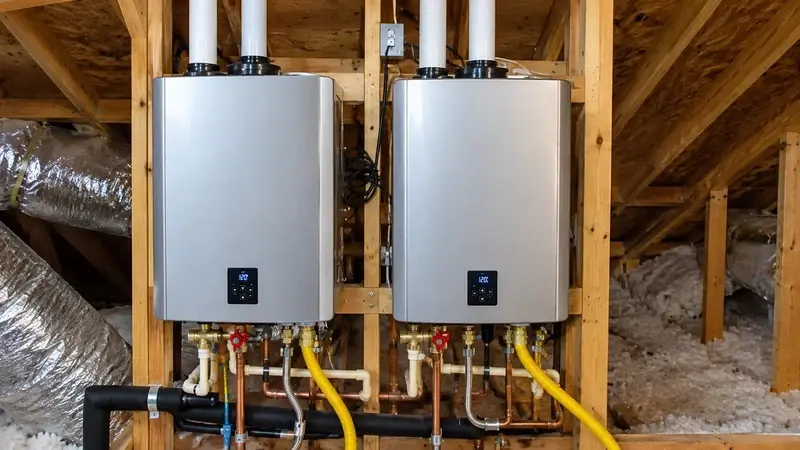
In a townhouse, a bungalow or a condo, the water heater closet is often the biggest closet in the home, and it is full of a 40-gallon tank that does nothing for twenty-three hours a day. Replacing it with a tankless unit the size of a carry-on suitcase gives that space back. That is the design argument, and it is a good one. The engineering argument is where the unit goes, what feeds it, and whether it is sized for the way the household actually uses hot water. Get those three right and a tankless heater is the best upgrade a small home can make. Get them wrong and the family blames the technology for a problem that was a sizing error.
What a tankless unit actually needs
A tankless water heater heats water as it passes through a heat exchanger, so it has no tank and no standby loss. To do that it draws a lot of energy for a short time, and that changes the installation.
A gas unit of the size most homes need burns around 150,000 to 199,000 BTU per hour at full output, against 30,000 to 40,000 for the tank it replaces. The gas line that fed the old tank is often too small; a 3/4-inch line from the meter, sometimes a larger meter, is common. Gas units also need a vent, and most modern condensing units vent horizontally through PVC rather than up the old metal flue, plus a condensate drain for the acidic water they produce.
An electric whole-house tankless unit needs heavy electrical service: three or four 40-amp double-pole breakers on a 200-amp panel is typical, which an older home with a 100-amp panel cannot supply without a panel upgrade. In Houston, where gas is available to most homes, gas is usually the practical choice for whole-house tankless; electric units make sense as point-of-use heaters for a single remote bathroom.
Both types need a cold supply in, a hot supply out, isolation valves with service ports for the annual flush, and enough clearance to be serviced.
The four places it can go
| Location | Advantages | Watch for |
| The old water heater closet | Gas, water and often a drain already nearby; closet floor becomes storage | Vent route to an exterior wall; combustion air if the door is solid |
| The garage | Space, easy venting, easy service access | Distance to upstairs bathrooms; a recirculation line usually needed |
| An exterior wall, outdoor unit | No vent at all; reclaims every inch of interior space | Freeze protection must stay powered; exposed pipes insulated; Houston freezes every few winters |
| The attic | Possible in slab homes with no closet | Poor service access; needs a pan with a drain line to the outside; a leak drips through a ceiling |
For a small home, the closet and the exterior wall are the two best answers. The closet keeps the plumbing runs short, which keeps the wait for hot water short. The exterior wall removes the unit from the interior entirely and is the simplest installation of all in a mild climate, with the one caution that its freeze protection needs power during a cold snap.
Sizing is the whole game
Tankless units are rated in gallons per minute at a given temperature rise, and both halves of that rating matter. Flow is how many fixtures run at once. The question is not how many fixtures the home has, but how many are open at the same moment on the busiest morning.
| Fixture | Typical flow, gallons per minute |
| Shower (standard head) | 2.0 to 2.5 |
| Shower (rain head or multiple outlets) | 3.0 to 5.0 |
| Bathroom faucet | 1.0 to 1.5 |
| Kitchen faucet | 1.5 to 2.2 |
| Dishwasher | 1.0 to 1.5 while filling |
| Washing machine | 2.0 to 3.0 while filling |
| Soaking tub filler | 4.0 to 7.0 |
Temperature rise is the difference between the incoming water and the set point, usually 120°F. Houston’s incoming water is warm most of the year, around 70°F or more in summer, so the rise is about 50 degrees and the unit delivers close to its headline flow. In January the incoming water can drop toward the 50s, the rise climbs to 65 or 70 degrees, and the same unit delivers noticeably less. Size for January.
Putting the two together: a one-bathroom home where nobody showers while the laundry fills needs a unit that delivers about 4 to 5 gallons per minute at a 70-degree rise, which is a mid-size gas unit.
This is the step to involve a plumber before the unit is bought. A company that does tankless water heater installation in Houston regularly will count the fixtures, check the gas line size and the panel, confirm the vent route, and tell you which unit the house can actually support.
The hot-water wait, and recirculation
The one complaint tankless owners have is the wait. A tank keeps hot water sitting in the pipes between uses; a tankless unit starts cold and has to push the cold water out of the line before hot arrives. In a small home with short pipe runs that is a few seconds. In a long, narrow townhome with the unit in the garage and the shower three floors up, it can be a minute, which is also several gallons down the drain every time.
A recirculation pump solves it by keeping the hot line primed. There are three ways to run it: on a timer for the hours the household uses hot water, on demand with a button or motion sensor near the far bathroom, or continuously, which wastes energy. Many tankless units now have the pump built in. If the home has no dedicated return line, a crossover valve under the far sink lets the pump use the cold line as the return. For a spa-style bathroom at the far end of the house, plan for recirculation at the outset; it is a small addition during installation and an annoying one afterward.
Hard water and the annual flush
Houston’s water is hard, and a tankless heat exchanger has narrow passages that scale up faster than a tank does. Left alone, the unit loses efficiency first, then starts throwing flow or temperature error codes, then fails early. The fix is an annual descaling: a small pump circulates a vinegar or citric solution through the heat exchanger for about an hour via the isolation valves, then flushes it clean. Insist on those isolation valves at installation; builder installations frequently omit them, and without them the flush means disconnecting the unit.
If the unit is already showing error codes, cycling on and off, or delivering less hot water than it did, scale is the first suspect, and tankless water heater repair usually starts with a descaling and a look at the inlet filter before any part is replaced. A whole-house softener removes the problem altogether and protects the faucets, the dishwasher and the glassware as well; in a hard-water area it is worth pricing alongside the heater.
| Maintenance task | How often in Houston water | Who |
| Clean the cold-water inlet filter screen | Every 6 months | Homeowner |
| Descale the heat exchanger | Yearly (every 6 months with a softener absent and heavy use) | Plumber, or homeowner with a flush kit |
| Check the condensate drain and neutralizer (condensing units) | Yearly | Plumber |
| Inspect venting and combustion | Yearly, with the descale | Plumber |
| Confirm freeze protection has power before a cold front | Each winter | Homeowner |
What it costs to run, honestly
A tankless unit uses less gas or electricity than a tank because it does not keep 40 gallons hot around the clock. The saving is real but modest in a small household, because a small household does not waste much standby heat to begin with. Energy guides put the difference for a low-use home in the tens of dollars a month, not hundreds. The better reasons to go tankless in a small home are the space, endless hot water for one shower at a time, and a service life roughly twice that of a tank when it is descaled. Buy it for those, and the lower bill is a bonus.
When a tank is still the right answer
Tankless is not automatically the upgrade. If the home has a 100-amp electrical panel and no gas, a whole-house electric tankless unit is usually out of reach. If the household has three teenagers showering in the same half hour, a 75-gallon tank delivers that peak more cheaply than two tankless units. If the budget is tight and the existing tank has simply failed, a like-for-like water heater replacement in Houston is a half-day job at a fraction of the cost of converting the gas line and venting. A plumber who quotes both side by side is giving you the honest comparison; one who quotes only tankless is selling a product.
The closet afterwards
Once the tank is gone, the closet it lived in usually has a floor drain or a pan, a gas stub and a vent penetration. Have the plumber cap what is unused and leave the pan if a tankless unit is going on the wall above it. Then the designer takes over: shelving, a stacked washer and dryer, or simply a closet that closes. In a small home that reclaimed space is the real return on the project.
From the installers
Royal Flush Affordable Plumbing, a Houston plumbing company that installs and services tankless water heaters across the city, gives small-home owners the same advice every time: decide the location by the gas, the vent and the distance to the showers, not by where the old tank happened to sit; size for January and for the busiest ten minutes of the morning; and have the isolation valves put in on day one so the annual flush is a routine, not a project.